Showing posts with label equity. Show all posts

21 January 2008

Cameroon: Climate Change Will Have Dreadful Consequences - Experts

Journalists are being trained to keep a keen eye on the potential shocks and trends that climate change will put in motion that can scupper economic growth options for Cameroon.
Source: The Post (Buea) by Kini Nsom & Ernest Sumelong

Climate change may soon have a toll on Cameroon's agriculture, economy and health, experts have revealed.
They raised the concern on Monday, January 14, during a training course on reporting climate change, organised by the British High Commission in Yaounde."Our activities - felling trees, burning bushes and emitting gases into the atmosphere - have direct consequences on our environment. We must regulate them to prevent impending consequences of climate change," Dr. Gabriel Tchatat, one of the facilitators told The Post.
Tchatat said global warming, which is an indicator of climate change, will cause the disappearance of watersheds, savannah and lakes like the Lake Chad watershed and so on.
According to him, demography, agriculture, industries, urbanisation, deforestation etc., cause climate change.
Other facilitators - Drs. Joseph Amougou, Jacob Tche and Ernest Moloua - corroborated Tchatat; adding that there can hardly be economic development in Cameroon without considering climate change.
"Everybody is concerned about this; there would be loss of biodiversity, fertile lands and increase in pests. "Agriculture contributes 40 percent of the Gross Domestic Product, GDP, and that is really important for our economy," Dr. Moloua posited.
"Without integrating climate change in every project, there can be no development," Amougou argued.The researchers cited residents of Douala and the northern provinces of Cameroon who are already suffering from excessive heat and diseases.
Climate change became a major concern when President Paul Biya addressed the UN General Assembly in Geneva in November 2007. He announced the creation of the Climate Change Observatory, even though it is yet to go operational.
However, the researchers faulted government for failing to make concrete efforts in spite of its pledge to fight climate change. They also said government has failed to communicate and get the population involved. Administrative authorities at the training admitted that communication is important if the population must understand and participate in the fight.
Thus, the facilitators maintained that journalists must, through environmental reports, educate the population on what role they can and should play in fighting climate change.
Meanwhile, the course instructor Janet Barrie, former BBC news presenter, urged reporters to write stories that will cause people to act.

11 January 2008

CLIMATE CHANGE and HEALTH: Malaria buzz


Climate Change Fueling Malaria in Kenya, Experts Say
Eliza Barclay in Tumutumu, Kenya
for National Geographic News
Esther Njoki lay on a slender cot in the women's ward of Tumutumu Hospital, lucid for the first time in days after being ambushed by fever and delirium. The emaciated 80-year-old had survived a bout of malaria, but her doctor said it nearly killed her.
Malaria has long been endemic to Kenya's humid coast and swampy lowland regions, but it has only rarely reached Njoki's village on the slopes of Mount Kenya (see Kenya map).
In recent decades, however, scientists have noted an increase in epidemics in the region, as well as in sporadic cases like Njoki's.
Many medical and environmental experts attribute the spike in malaria to climate change, in the form of warmer temperatures and variations in rainfall patterns. (See a map of global warming's effects.)
"We are now finding malaria in places that we did not expect to find it, particularly the highland regions that used to be too cool for malaria," said Dorothy Memusi, deputy director of the Malaria Division in Kenya's Ministry of Health.
Parasites, Mosquitoes Affected by Climate
Malaria is an infectious disease caused by parasites in the blood system. Symptoms include fever, severe joint pain, and in extreme cases, anemia—a deficiency in red blood cells—because the parasites use red blood cells to reproduce.
Changes in temperature can affect the development and survival of malaria parasites and the mosquitoes that carry them, according to a joint 2004 study by the State University of New York, Buffalo, and the Kenya Medical Research Institute.
Rainfall also influences the availability of mosquito habitats and the size of mosquito populations, the research found.
Shem Wandiga is a professor of chemistry at University of Nairobi who has studied the relationship between climate and malaria.
He said malaria epidemics first appeared in Kenya's highlands in the 1920s, but during the last 20 years, the frequency of outbreaks in the region has been more pronounced.
"The best climate conditions for malaria are a long rainy season that is warm and wet, followed by a dry season that is not too hot, followed by a hot and wet short rainy season," Wandiga said.

10 January 2008

CLIMATE CHANGE and ECONOMIC EQUITY: The People's Car arrives in India


Climate change evangelists are in uproar over the launch of Tata's latest locally-relevant innovation, the 'People's car'. With sales of cars going up, emissions worries are compounded by incomplete information and a lack of thinking about the equity [economic and social] that India's population deserves. First, the People's Car will replace inefficient emitting motos -- basically lawnmower engines working overtime. Second, these will be efficient petrol users and emitters -- assuming higher passenger loads. Third, safer [hopefully]. Fourth, benchmarking efficiency, price and quality in the Indian automotive sector for all other manufacturers, designers and planners to follow. Fifth, locally built enhancing multipliers. And finally, from an "ecological space" viewpoint, Indian consumers have a lot of carbon spare to burn in economically enriching ways. The People's Car is not perfect, but it is way better than consuming imported cars.

Tata says: "Indian car sales are predicted to more than quadruple to $145bn by 2016. Company chairman Ratan Tata said the launch of the Nano was a landmark in the history of transportation. Further, the car was "a safe, affordable and all weather transport - a people's car, designed to meet all safety standards and emissions laws and accessible to all".
Environmental critics have said that the car will lead to mounting air and pollution problems on India's already clogged roads. The car had passed emission standards and would average about 50 miles to the gallon, or five litres per hundred kilometres.

08 January 2008

CLIMATE CHANGE AND EQUITY: Kenya Hit By Food Shortage After Poor Rains


Poorer rains in the Greater Horn of Africa region are forecast to spell bleak futures for pastoralists and all those who rely on their production system for cheap protein [nyama choma]. Climate change is expected to exacerbate these trends, spelling potential disaster for the pastoral communities and for the macroeconomy as imports of protein will need to rise and the management of rangeland is reduced. Fortunately, we can expect a rise in price/value of such meat, increasing incentives to be involved.
Source: BuaNews (Tshwane)
Judith Akolo
The long-term implications of last year's poor rain seasons in the Greater Horn of Africa region, affecting mostly Kenya, will be bleak.
Kenya, as well as Uganda, Somalia, Ethiopia, Eritrea, Sudan, Tanzania, Rwanda and Burundi, are experiencing a shortage of pasture for animals, poor crop harvests and reduced drinking water availability due to insufficient rainfall during the short-rains period last year.
This is according to Famine Early Warning Systems (FEWSNET), which is funded by the United States Agency for International Development (USAID).
The worst hit area is to be central Kenya, with impacts being felt in southern Kenya and parts of Somalia and Ethiopia.
Poor rainfall during the 2007 short-rains season has left southern portions of Kenya with insufficient pasture, drinking water and crop yields.
The northern pastoral areas of Kenya have also experienced a below normal short-rains season, the FEWSNET report says.
While control operations are ongoing following a locust invasion in parts of northern Kenya, the current situation is threatening livelihoods, because of a shortage of pasture and browse for livestock.
Some locations in the area have also experienced two consecutive seasons of failed rainfall.
Kenya is also currently experiencing political unrest following the announcement of President Mwai Kibaki, as winner of the 27 December presidential election.
Opposition leader Raila Odinga disputes the election result which gave victory to President Kibaki by a very narrow margin and he accused the president of rigging the election to stay in power.
British Prime Minister Gordon Brown earlier this week appealed to Kenya's political leaders to urgently hold talks to end the riots in which more than 300 people are reported to have died.
All local radio and television stations in Kenya on Sunday evening aired a special joint prayer session for peace.
The one-hour programme dubbed "Prayer for peace, Kenyans unite", involved leaders from the Catholic, Baptist and Pentecostal churches, as well as from the Muslim and Hindu faiths, who converged to pray for peace, unity, truth and justice.

03 January 2008

CLIMATE CHANGE TRADE SCAREs OVER: Kenya's Horticulture Sector Upbeat On 2008 Forecast


Source: Business Daily (Nairobi) by Allan Odhiambo
It may have had its share of breath taking scares across the year, but players in the robust horticulture industry are looking up to success in the coming year.
First to rattle the sub-sector was the food miles concept that threatened to lock local producers from key markets especially in Europe on grounds that shipments from far flung areas were contributing to global warming through carbon emissions.
Proponents of this concept argued that to discourage such threats of environmental degradation, all produce brought in through long haulage should be accorded cautionary labels such that buyers 'skipped them' for locally produced ones.
Then came a strengthening shilling against major international currencies such as the dollar that eroded producers' earnings from exports prompting a debate over possible switch to other currencies to avoid further damage.
That aside, there were the jitters of expiring preferential trade agreements that would have disrupted export trade with the EU come December 31.
"It has been a tough year for exporters" Hasit Shah, the vice chair at the Kenya Flower Council (KFC) says.
Luckily the industry 'lived through' these scares and analysts say it could be headed for firmer performance compared to last year, going by the strong run over the first half of this year.
The carbon miles debate was fizzled out by the fact that its proponents would not scientifically justify their claims against the long haul products while the fears of trade disruptions were put to rest after Kenya and other East African Community (EAC) member States initialised new trade deals with the EU waiting the signing of comprehensive Economic Partnership Agreement (EPA) by 2009-guaranteeing continued duty/quota free access of their goods into Europe.
The industry's spirits are further buoyed by statistics from the Leading Economic Indicators for September released by the Planning and National Development Ministry that showed the industry's earnings hit the Sh31 billion mark as at June, representing a 57 per cent growth over a similar period last year backed by a strong demand for cut flowers in key international markets.
Kenyan horticulturists have particularly cashed in on sharp changes in weather patterns over Europe where the bulk of exports are taken. Traditionally, the onset of summer in Europe towards June spelt lower sales for Kenyan horticultural exporters as their counterparts in the EU upped own business in the warmest months for the northern hemisphere.
This year, however, unstable weather patterns attributed to global climate change has set back horticultural production programmes in regions such as the UK, and that has meant a stronger than usual demand for imports from countries like Kenya.
Analysts now predict that backed by this massive growth, the industry is likely to surpass the Sh43 billion full-year earnings for last year.
"We look up to a very successful 2008 because massive transformations are being carried out," Jane Ngige, the chief executive officer at KFC told Business Daily.
The CEO says growth in the industry is likely to come from stronger audit of operations especially among the upcoming smallholder producers which would reduce the rate of rejection of goods turned up from trading in key markets.
Faced by stringent market safety requirements players in the industry have moved to adopt practices such as Kenya Good Agricultural Practices (Kenya-Gap) protocol to counter the threats with an aspect of self regulation now ensuring the country's producers and exporters maintained an emphatic run in key markets abroad.
Based on the successes of this concept of self regulation, a recent survey by the Food and Agriculture Organisation (FAO), titled : "Bridging the Gap Between Food Safety Policies" labels the Kenya horticulture industry as a global illustration of how standards can be used to tackle competition in key markets.
The UN agency said that through investments in high-care processing facilities, private laboratories, full supply chain traceability, improved sanitation, storage systems and Hazard Analysis and Critical Control Point (HACCP) measures, the leading firms in Kenya's fresh produce industry have focused their attention and resources on premium-quality market segment and reaped significant benefit.
"In spite of more stringent standards applied by certain importing countries, some industries and supply chains in low-income countries have maintained or enhanced their competitiveness and market share," the document reads in part.
This concept of self regulation in Kenya has been bolstered by the recent accreditation of the Kenya Plant Health Inspection Services (KEPHIS) to carry out inspections of exports on behalf of the EU.
Previously, exports were checked for standards locally and later re-examined in Europe.
A step to harmonise the inspection procedure has however improved fortunes for Kenyan exporters in that their produce is only inspected once by Kephis and a binding certificate, application even in Europe, issued to them.

23 December 2007

SUPERMARKETS and MOZAMBIQUE: Small-scale farmers become entrepreneurs


In Mozambique if you shop at Shoprite, Africa's largest food retailer, with operations in 16 countries, you'll be buying vegetables produced locally by small-scale farmers.
The IFAD-funded Agricultural Markets Support Programme (PAMA) supports the implementation of major economic reforms launched by the government during the 1990s, including the commercialization of small-scale farming through better access to markets and improved linkages with private-sector operators.
The programme, funded by a US$23.6 million loan, enables small-scale farmers in Boane, 30 km south of Maputo, to grow cabbages, potatoes, tomatoes and other cash crops in the rehabilitated irrigation schemes that were severely damaged during 16 years of civil war. Today, in the Boane area, the irrigation schemes cover 405 ha of land and the programme works with approximately 400 farmers.
The PAMA team worked hard to get the farmers to where they are today. "Before we came into the picture, farmers produced low-quality products. They were unable to sell directly to the buyer and had no idea of how to link up with big buyers. At best they sold their goods through intermediaries or at farm gate, and had little or no negotiating power," said Rui N. Ribeiro, PAMA coordinator. "Now they are organized in associations and as a result have more bargaining power."
PAMA's vision was to enable farmers to produce high-quality products and to link them directly to the market. Thanks to the programme, farmers are using fertilizers and improved seedlings to produce high-value crops that they sell to supermarkets, hotels, restaurants and the main hospital in Maputo.
Strengthening capacity and institutions, and influencing policy To enter the market and trade with commercial entities, farmers needed to issue invoices and receipts. To do that they needed to become a legal entity, and consequently they had to organize themselves into associations. PAMA facilitated the creation of farmers’ associations, organized marketing committees and helped farmers conduct market research.
"Before the programme's intervention, registering as an association was a costly affair and immense challenge," said Alessandro Marini, IFAD Country Programme Manager for Mozambique. "The programme, together with other stakeholders, lobbied with the government and raised awareness about the importance of having an easy process for registering associations," said Marini.
As a result, the Government of Mozambique passed a new law on decentralizing registration formalities to the district level. The government is also developing and implementing marketing strategies and pro-poor programmes supporting market linkages.
Thanks to the efforts of Ribeiro and his team, the farmers’ associations are now well established in the market. Each association has a president, treasurer and secretary.
The programme is providing marketing and production specialists and two supervisors who provide continuous technical assistance. The associations now are supported by a marketing committee responsible for coordinating production and marketing activities. The marketing committee meets with buyers to determine their needs, negotiate prices and deliver products.
Building social capitalFarmers’ associations built their credibility and reputation by encouraging buyers to visit their plots to check the quality of products. To ensure that quality was up to par, the project arranged for a visit by a nutritionist who examined and approved the products.
Subsequently the farmers visited the supermarket, where they were able to examine the quality of the products on the shelves.
"We took this opportunity to discuss our needs with the farmers," explained Pine Oppesmon, fruit and vegetable manager at Shoprite. "For example, we told them we needed tomatoes that were half-green because they have a longer shelf life, and that we would buy potatoes from them only if they had been washed."
"Since we started buying from the associations, the supermarket’s revenue has increased by 4 per cent," said Oppesmon. "You know, labour is much cheaper here than in South Africa. Now I am buying 25 per cent of products locally. I hope one day I'll be able to buy 80 to 90 per cent of products locally." He added, "These guys have a great potential, they are producing at European standards. If they get a bit better in packaging, they will make a quantum leap."
Going one step further "My vision is to expand the association's activity and start working with agro-processing industries and become equipped to do better packaging," said Mula, the Massaca association’s president. "Today farmers sell excess or low-quality products as animal feed. Linking them to agro-processing industries would mean, for example, that they would be able to sell ripe tomatoes for tomato paste and increase income-generating activities.”
For further information, please contact: Alessandro Marini, Country Programme Manager, Eastern and Southern and Africa DivisionEmail: a.marini@ifad.org

19 December 2007

CLIMATE CHANGE and ECONOMIC EQUITY: can industry match the efforts of citizens?


Source: INSNET

Dutch Sustainability Research (DSR) and Respect published findings of a benchmarking study on climate change best practice. The research indicates that corporations are taking part in numerous interesting and innovative climate change related initiatives. However, overall climate change disclosure remains patchy and inconsistent and it therefore remains difficult to determine real leadership.The report urges corporations and policy makers to promote accountability and stimulate best practice in the field of climate change. To this end, corporations and policy makers should further stimulate meaningful, focussed and standardised reporting on climate change. As comment to the benchmarking study, Kaj Embrén, partner of Respect, says:
All the companies in this study show that they have a formal statement on Climate Change, but only 45 % have formulated corporate targets and clear deadlines in terms of GHG-gases. So, it is important to strengthen the work with target setting in the companies further
DSR reviewed the performance of 20 corporations on a selected number of climate change best-practice indicators drawn from international guidelines. The study shows that companies are keen to demonstrate leadership in this field. There is no indication that climate change action compromises financial performance. The study however also reveals that climate change related reporting remains fragmented. Data needs to be gathered from various documents including annual reports, sustainability reports, and websites. Overall, it remains difficult to assess actual corporate leadership on climate change.
Hans-Ulrich Beck, Research Director at DSR, explains: “The difficulty stems mainly from the fact that data disclosed is not easily comparable given the scope and methodologies applied. Furthermore, current disclosure often fully omits material emission sources in particular from the use of products.”
The study highlights that the lack of transparency will make it difficult for climate change leaders to reap the full benefits of climate change leadership such as strengthened reputation or brand awareness. Similarly, there is little pressure for laggards to take action. In order to promote corporate leadership, steps need to be taken to increase corporate accountability and access to meaningful climate change data.
In order to promote transparency and corporate best-practice in the field of climate change, the study urges corporations and policy makers to take necessary steps to:
· Promote more consistent, meaningful, and focussed corporate reporting on climate change; · Facilitate public access to corporate climate change data through a public climate change repository · Provide more visibility to climate change leaders through third party climate change accountability/transparency certification; and
· Reward specific performance standards or emissions reduction achievements through third party climate change leadership labels

18 December 2007

CLIMATE CHANGE and TRADE EQUITY: Can trade rules be leveraged to reduce climate change?

Pascal Lamy, the Director of the WTO hints at how the WTO tool-box of rules can certainly be leveraged in the fight against climate change. Normally, the WTO has rules on product standards that encourage its members to use the international norms and this would be defined only by a consensual international accord on climate change that successfully embraces all major polluters. He uses the "food miles" debate to illustrate how far away both this global consensus is and our understanding of climate cause and effects.
Source: Business Daily (Nairobi) by Pascal Lamy
The issue of Climate Change intersects with international trade in a multitude of different ways. While the World Trade Organisation does not have rules that are specific to energy, to the environment or to climate change per se, there is no doubt that the rules of the multilateral trading system - as a whole (i.e. the WTO "rule book") - are indeed relevant to climate change.
Today, there are many different perceptions of what the trading system ought to do on climate change. While some would like to see the trading system curb its own "carbon footprint," through the greenhouse gas emissions it generates in the course of the production, international transportation, and consumption of traded goods and services; others would approach the issue differently.
Some would like to see the trading system offset any competitive disadvantage they suffer in the course of climate change mitigation. More specifically, they would like to impose an economic cost on imported products at their borders equivalent to the one they suffer in curbing their own emissions.
In other words, a "levelling of the playing field" of sorts, if you will, based on an importing country's perception of how that field may best be levelled.
And, of course, there are many different ideas floating on what these "offsetting" measures may be, with most of the discussion naturally focussing on countries' most trade-exposed, energy-intensive, economic sectors like iron and steel and aluminium.
For instance, while some are considering the imposition of domestic carbon taxes, with adjustment for those taxes at their border; others are contemplating emission cap-and-trade systems, with an obligation upon importers to participate in those systems.
Yet another group would prefer to focus on what is most immediately "deliverable" - if I may say so - by the trading system in terms of the fight against climate change. And by this, they mean the opening of markets to environmental goods and services; in particular to those that are relevant to climate change, through the ongoing Doha Round of trade negotiations.
These are but a few of the ideas I have heard so far on how some would like to position the multilateral trading system on climate change. But there are other ideas for sure, and much work is being conducted at the moment - in various quarters - on how the WTO tool box of rules may be leveraged in the fight against this environmental challenge. While some are looking at WTO rules on taxes, others are looking at the rules on subsidies and intellectual property for instance.
My starting point in this debate is to say that the relationship between international trade - and indeed the WTO - and climate change, would be best defined by a consensual international accord on climate change that successfully embraces all major polluters.
In other words, until a truly global consensus emerges on how best to tackle the issue of climate change, WTO Members will continue to hold different views on what the multilateral trading system can and must do on this subject.
There is no doubt that trade regulations are not, and cannot be, a substitute for environmental regulations. Trade, and the WTO toolbox of trade rules more specifically, can - at best - offer no more than part of the answer to climate change. It is not in the WTO that a deal on climate change can be struck, but rather in an environmental forum, such as the United Nations Framework Convention on Climate Change.
Such an agreement must then send the WTO an appropriate signal on how its rules may best be put to the service of sustainable development; in other words, a signal on how this particular toolbox of rules should be employed in the fight against climate change.Absent such a signal, confusion will persist on what would constitute an appropriate response by multilateral trading system.
Let us take the issue of the international trading system's carbon footprint for instance. Much is said in the press everyday about the carbon footprint of international transportation.
In fact, a new and emerging concept is that of "food miles." In other words, the desire of consumers in certain countries to calculate the carbon emitted in the course of international transportation, with many already drawing the conclusion that it may be better to "simply produce goods at home" to minimize emissions.
But that argument does not always stand up to empirical verification. In fact, 90% of internationally traded goods are carried by sea. And maritime transport is by far the most carbon-efficient mode of transport, with only 14 grams of CO2 emissions per ton kilometre.
Shipping is followed by train transport, then road transport. Air transport has by far the highest CO2 emissions per ton kilometre (a minimum of 600 grams), illustrating the high relative climate impact of such transport.
For instance, some studies show that a Kenyan flower that is air-freighted to Europe emits a third of the CO2 of flowers grown in Holland. Others show that New Zealand lamb that is transported to the United Kingdom can actually generate 70 per cent less CO2 than lamb produced in the UK.
Only a multilateral approach to climate change would allow us to properly address these issues. A multilateral agreement, that includes all major polluters, would be the best placed international instrument to guide other instruments, such as the WTO, as well as all economic actors on how negative environmental externalities must be internationalized. Only with such an instrument can we move towards the proper pricing of energy.
The WTO tool-box of rules can certainly be leveraged in the fight against climate change, and "adapted" if governments perceive this to be necessary to better achieve their goals. The WTO has rules on product standards for instance, that encourage its members to use the international norms set by more specialized international institutions.
The WTO has rules on subsidies, taxes, intellectual property, and so on. All of these tools can prove valuable in the fight against climate change, but in that fight, would need to be mobilised under clearer environmental parameters that only the environmental community can set.
Surely we should not miss an opportunity to open markets for clean technology and services in the Doha negotiations. But, in doing so, we should cognizant of the fact that, ultimately, it is the existence of environmental regulations that will drive demand for these goods and services.
Hence the importance, once again, of setting the right environmental framework within which market opening can take place.
The writer is the director-general of WTO.

14 December 2007

EQUITY and HUNTING: rural poor benefit from elephant hunting


Source: The Namibian (Windhoek)
EVERY member of the 5 000-strong San community in the Bwabwata National Park in the Caprivi Region received N$136 from the Kyaramacan Association in October.
The Association, representing San people living in 10 villages in the newly proclaimed park, was given hunting rights in the park by the Ministry of Environment and Tourism.
It generates money from trophy hunting and meat sales.
The Integrated Rural Development and Nature Conservation (IRDNC) project leader in West Caprivi, Friedrich Alpers, says a total amount of N$300 000 was distributed among the association's members.
Alpers said 16 elephants were hunted during the year and the meat was given to the community for domestic consumption.
"They had about 30 000 kg of elephant meat," he said.
Alpers said the association's members have indicated that they will use the money to pay their children's school fees and buy food.
For the past two years, the Kyaramacan Association has contributed N$1,2 million a year to the Ministry's Game Products Trust Fund, which finances conservation projects and compensates people for losses caused by wild animals.
According to the agreement signed between the Government and the association, 50 per cent of the income generated from trophy hunting must be handed to the Fund.

13 December 2007

CLIMATE CHANGE AND EQUITY: Namibia: Poor 'Will Be Hit Hard' By Climate Change

Source: SciDev.Net (London) by Carol Campbell

Climate change is expected to dramatically alter the lifestyles of poor people in Namibia, say the authors of a study.
Their findings were published by the UK-based International Institute for Environment and Development (IIED) this month (December).
Namibia is economically dependent on natural resources. Up to 30 per cent of its gross domestic product (GDP) is estimated to be reliant on the environment. Climate change could increase temperatures by 2-6 degrees Celsius by 2100, and rainfall is expected to be lower and more variable.
The researchers used data from Namibia's natural resource accounts to model the economic impact of climate change.
They found that under a best-case scenario over 20 years, the overall GDP would fall by about one per cent (about US$70 million). But under a worst-case scenario, livestock farming would be hit hard, fishing production would be greatly reduced and GDP would fall by almost six per cent (about US$200 million).
Even in the best-case scenario, subsistence farming would be greatly reduced and a quarter of the population would eventually have to find new livelihoods.
Extreme events like drought are expected to become more common, while changes in sea temperature will play havoc with the fishing industry. Economic diversification will be an important development strategy in future, especially in farming and coastal communities.
Phoebe Barnard, founder of Namibia's national climate change programme, now based at the South African National Biodiversity Institute in Cape Town (SANBI), told SciDev.Net that a detailed modelling study of climate change impacts on Namibian biodiversity and ecosystems was conducted by SANBI for Namibia in 2003.
The SANBI study projected significant additional bush encroachment of the savannah under climate change, and an expansion of Nama Karoo-type (dwarf shrubland) habitat.
"This will severely compromise the livestock production sector, one of Namibia's main livelihoods, and put pressure on the ecology of areas marginal for farming," said Barnard.
"It is up to industrialised nations -- the most responsible for climate change -- to help Namibia and other vulnerable countries cope with the impacts and plan for a climate-constrained future," says the study.

12 December 2007

CLIMATE CHANGE and EQUITY: Namibia's poorest lose out


Natural resource based economies in Africa to be hit hard economically by climate change with the poorest paying the highest relative price.

Source: The Namibian (Windhoek) ... "Climate Outlook Grim - Study" by Absalom Shigwedha


The impact of climate change on Namibia's natural resources alone could reduce the country's Gross Domestic Product by one to six per cent, says an opinion paper by four climate change experts.
The paper, 'Counting the cost of climate change in Namibia', was compiled by Hannah Reid of the London-based International Institute for Environment and Development (IIED), James MacGregor (IIED), Linda Sahlen of Umea University and Jesper Stage of Goteborg University It was launched at the conference of parties to the United Nations Convention on Climate Change (UNFCCC) currently on in Bali, Indonesia.
"Its [Namibia's] natural legacy underpins much of the national bank balance - and also leaves it highly vulnerable to climate change," said the two-page paper. It is estimated that up to 30 per cent of Namibia's GDP is reliant on the environment. The paper said there was a need for Namibia to mainstream climate change into national policies and planning. Employment opportunities, it says, could shrink and wages fall, with wages for unskilled labour dropping by 24 per cent in worst-case scenario. "So, along with climate change policies and activities, Namibia needs a strategy to deal with displaced farmers and farmworkers," said the paper. Low rainfall is particularly expected in the central regions, while overall rainfall is projected to become even more variable that it is now.
"Even if rainfall changes little from today's levels, hotter temperatures will boost evaporation rates, leading to severe water shortages. Poor rural pastoralists and dryland populations will be affected most. Extreme events such as drought are likely to become more frequent and more intense," said the four experts.
They said it was up to industrialised nations - the most responsible for climate change - to help Namibia and other vulnerable countries to cope with the impact.

10 December 2007

CLIMATE CHANGE, EQUITY and MARKETS: Stern warning

Nicolas Stern estimates the extra costs developing countries face as a result of climate change are likely to be upwards of $80bn per year and it is vital that extra resources are available for new initiatives.
Source: Royal Economics Society
Climate change is a result of the greatest market failure that the world has seen, Sir Nicholas Stern, whose review last year warned of the economic and social costs of climate change, said tonight.
Delivering the Royal Economic Society (RES) public lecture in Manchester, ahead of next week's world summit on climate change in Bali, Sir Nicholas said targets and trading must be at the heart of a global agreement to reduce greenhouse gas emissions.
"The problem of climate change involves a fundamental failure of markets: those who damage others by emitting greenhouse gases generally do not pay," said Sir Nicholas.
"Climate change is a result of the greatest market failure the world has seen. The evidence on the seriousness of the risks from inaction or delayed action is now overwhelming. We risk damages on a scale larger than the two world wars of the last century. The problem is global and the response must be a collaboration on a global scale."
He added that rich countries must lead the way in taking action. "That means adopting ambitious emissions reduction targets; encouraging effective market mechanisms; supporting programmes to combat deforestation; promoting rapid technological progress to mitigate the effects of climate change; and honouring their aid commitments to the developing world," he said.
Sir Nicholas used the RES lecture - entitled, Climate Change, Ethics and the Economics of the Global Deal - to set out a six-point global deal for tackling climate change.
The first involves rich countries reducing their greenhouse emissions by at least 80% - either directly or through trading schemes - in order that the overall 50% reduction in global emissions by 2050 is met.
Secondly he called for substantial trade between countries, including rich and poor countries, in greenhouse gas emissions.
The third point requires a major reform of the clean development mechanism, a Kyoto protocol mechanism that allows developing countries to sell emission reductions, but does not penalise them for emissions themselves, making it a "one-sided trade mechanism", said Sir Nicholas.
He also argued for an international programme to combat deforestation, which contributes 15-20% of greenhouse gas emissions.
"For $10-15bn (£4.8-7.2bn) per year, a programme could be constructed that could stop up to half the deforestation," he said.
There also needs to be urgent promotion of rapid technological advance for climate change mitigation, said Sir Nicholas.
Carbon capture and storage (CCS) for coal is particularly urgent since coal-fired electric power is currently the dominant technology round the world and emerging nations will be investing heavily in these technologies, he said.
"For $5bn a year, in terms of feed-in tariffs (which could be reduced as carbon prices rise), it should be possible to create 30 commercial scale coal-fired CCS stations within seven or eight years. Unless the rich world demonstrates, and quickly, that CCS works, developing countries cannot be expected to commit to this technology."
The final plank in Sir Nicholas's action plan is for rich countries to honour their commitments to 0.7% of GDP in aid by 2015. This would yield increases in flows of $150-200bn per year. The extra costs developing countries face as a result of climate change are likely to be upwards of $80bn per year and it is vital that extra resources are available for new initiatives.
Sir Nicholas argued that this global deal invokes effectiveness, efficiency and equity.
"The problem is deeply inequitable with the rich countries having caused the bulk of current stocks of greenhouse gases and the poor countries being hit earliest and hardest - which means that the rich countries must take the lead," he said.
"Within different countries, there will be different choices of instruments - such as taxes, trading and standards - and different technological mixes.
"In all countries, there is scope for energy efficiency, which both reduces emissions and saves money. But trading must be a central part of the story because it can provide the international incentives for participation, and promote efficiency and equity, while controlling quantities of emissions."
Sir Nicholas Stern said that his programme could be developed if rich countries take a lead in Bali on their targets, the promotion of trading mechanisms and funding for deforestation and technology.
He said: "Bali is an opportunity to draw the outline of the common understanding or framework, which will both guide action now, and build towards the deal."

Meat and equity: Zambia questions EU policies over imports and trade


Zambia's President Levy Mwanawasa questions EU policies over imports and trade complaining that Zambia is losing as much as $150 million annually on potential meat exports alone .... close to what the EU gives Zambia in grants every year.He called for delegates to find ways on how Africa and European nations can build a new relationship based on equality.

Source: The Times of Zambia (Lusaka)... Zambia: President Call for EU Countries to Open Up Their Markets to Africa

THE call by President Mwanawasa for European Union (EU) countries to open up their markets to African agricultural produce is a serious matter, which should be accorded the attention that it deserves. For a long time, African countries have been crying about the restricted access to the lucrative EU and other markets.
That Zambia is losing as much as $150 million annually on potential meat exports alone as a result of these trade restrictions is indicative of the magnitude of the opportunities that the EU has been denying African countries. This figure, according to Dr Mwanawasa is close to what the EU gives Zambia in grants every year.
This clearly demonstrates that Zambia and other African countries are capable of eventually standing on their own if only EU members and other developed countries could be supportive by offering them chance to trade equitably, instead of keeping them hooked on foreign aid.
In fact, Africa has always stated that it does not wish to live on hand-outs because it is capable of standing on its own with genuine support from the developed. Such support could entail the removal of some of the rigid packaging specifications and phyto-sanitary standards demanded by the EU.
The other way that the EU could help Zambia would be through the deliberate boosting of Africa's capacity to meet some of these measures demanded by the European nations, and allowing the country to trade itself out of aid dependency.
Europe can enable Africa to trade more equitably by removing agricultural subsidies, which make African produce uncompetitive on the EU market.
Of course, the EU cannot be expected to relax the trade restriction and open up its markets rapidly and at once, but there is room for the EU member states to remove some of the barriers and meet the African nations half way.
The EU-Africa Summit, which closed yesterday in Lisbon, was called to find ways on how Africa and European nations can build a new relationship based on equality. The suggestion made by Dr Mwanawasa is one way of achieving that.
The World has followed the deliberations of the summit in Portugal with keen interest and is waiting to see the results of the meeting.
Now is the time to implement the resolutions of the EU-Africa summit. Otherwise the meeting will be branded just another talking shop.

09 December 2007

EQUITY and GAS: how loudly purrs the tiger in your tank?

Nice data and graphical representation in this article ... but no purchasing power parity vibe ... still a good read, even if unrelative equity is the watchword.

Source: Foreign Policy ... "Prime Numbers: Pain at the Pump" by Gerhard Metschies
Drivers grumble about high gasoline prices all over the world. But with oil prices at record highs, many countries are saying goodbye to gas subsidies, making a trip to the filling station more expensive than ever.

Gasoline prices are based largely on the price of crude oil, but refining costs, distribution, and taxes also add to the tab. Some governments, such as Venezuela and Iran, pick up much of the bill through subsidies. But as the price of crude has risen, many countries have abandoned subsidies in favor of higher gas taxes. Indonesian motorists have perhaps been hit hardest: Gas prices there have increased a whopping 238 percent since 2000.
Countries that keep prices artificially low do so at the peril of their budgets’ bottom line. Iran’s subsidies cut into its total state spending by nearly 40 percent. On the flip side, gasoline taxation can help curb state deficits. South Korea’s high fuel taxes bring in 15 percent of the country’s spending

KENYA and sustainable development: Bank Gets Long Term Credit for SMEs


Smaller businesses in Kenya will get a new leg-up from leveraged cheaper finance from Fina Bank [through EIB]. The credit market in rural areas is one missing market that needs filling and could radically alter the profile of rural poverty.

Source: The Nation (Nairobi) Kenya: Fina Bank Gets Long Term Credit for Smes

Fina Bank's small and medium clients can now access long-term financing of up to 10 years following an agreement with the European Investment Bank (EIB) to provide funding.
Under the agreement signed on Friday, Fina Bank will receive Sh273 million (3 million euros) from the European bank's Sh1.8 billion (EUR 20 million) line of credit.
Mr Carmelo Cocuzza, the EIB head of regional representation for Central and East Africa, said the loans will be available in Kenya shillings, US dollars or Euros at either floating or fixed rates.
"Besides being long-term, the loans will be beneficial to the clients because they will be cushioned against the local interest rates fluctuations," said Mr Cocuzza.
Fina Bank group CEO, Mr Frank Griffiths, said the agreement will allow the banks to provide longer term loans to its growing number of SME customers.
"Expanding a business is not easy and being able to finance a project for up to 10 years will be greatly appreciated," said Mr Griffiths.
He added that the ability to offer up to a 10-year loan, in a variety of currencies, and with the option of a fixed rate of interest, is relatively unique in this market.
It targets the agro-industry, fishing, mining, food processing, manufacturing, tourism, education and health-care.

07 December 2007

TRADE and EQUITY: Namibian meat, economic dominoes


WINDHOEK: The Namibian government has made a bizarre decision which will cripple its lucrative export industry to the EU for fresh produce and meat -- seemingly for no gain, political or economic. New tariffs will AVERAGE 90% on all exports. Clever Namibians are buying shares in haulage companies, gas stations along the TransCaprivi and TransKalahari Highways. Meat-eating Namibians are wondering what this means for the local price of meat which has for a long time been subsidised by lucrative exports to the EU. Plus, the value of land is intimately linked to these high returns from exports - and cattle rangeland supports cattle and wildlife complementarily. The tourism industry, based around sustainable tourism [and community-based natural resource management, is equally watching these emerging events with a sense of loss and impending problems.


Source: The Namibian ... "Farmers Shocked About EU Trade Loss" by Brigitte Weidlich


SHOCKWAVES have rippled through the private sector since Government announced on Wednesday that it refused to sign a new trade deal to kick in on January 1 2008.
The signature would have safeguarded duty- and quotafree access of all Namibian agricultural produce, such as beef, grapes and fish, to the European Union (EU).
"Namibia is facing very stiff tariffs for beef imports to the EU, averaging 90 per cent, three weeks from now against the present eight per cent," said Juergen Hoffmann, Special Trade Advisor at the Agricultural Trade Forum (ATF).
"This is because the European Union does not grant GSP to any meat products," he said yesterday.
The Generalised System of Preferences (GSP) is a scheme whereby a wide range of industrial and agricultural products from some developing countries are given preferential access to EU markets.
An insider of the beef industry told The Namibian yesterday the steep increase in tariffs from next January would make it uneconomic to export beef to the EU.
Currently Namibia exports some 9 000 tonnes of beef a year to the EU.
"It is deboned meat and only the best pieces, being the prime cuts, are exported," said the person, who spoke on condition off anonymity.
"I would not be surprised at all if some abattoirs shut down in Namibia and jobs will be lost.
I also wonder if the Etunda feedlot, which is to be set up by Meatco near Ruacana with EU grant money, will actually come off."
Trade and Industry Minister Immanuel Ngatjizeko told reporters on Wednesday that Government would set up a special task team to assess the losses the beef, fish and grape producers will suffer.
"We can meet them only halfway," the Minister stated. The grape industry is also affected by the Government decision. It employs about 1 500 people permanently and 6 000 seasonal workers in southern Namibia. Namibia exports about 22 500 tonnes of table grapes, most of them to the EU.
The higher import tariffs of EU countries will amount to over N$300 million, which producers have to cough up next year to sell their grapes in Europe

CLIMIATE CHANGE and EQUITY: CC will hit Namibia's poorest


Namibia: Climate Change to Hit Key Economic Sectors
Climate change will impact the poorest - more evidence from the University of Namibia


Source: The Namibian (Windhoek) by Absalom Shigwedha

Namibia's agricultural production could drop by 13 per cent because of climate change, says a recent study by the University of Namibia.
Livestock production will also decrease. The report, titled 'Millennium Development Goals 7 and Climate Change: Challenges and Opportunities', was presented by Dr John Mfune, a lecturer at Unam, last Thursday.
Mfune, who was the co-ordinator of the study, said the country will also lose biodiversity and revenue from wildlife-based tourism because of climate change. However, Mfune said his team was happy to see that some rural people in the Oshana Region have already taken measures to adapt to climate change. Instead of sowing the traditional pearl millet (mahangu) that needs a lot rain, they have turned to drought-resistant Okashana mahangu, which matures fast even in drought conditions.
Mfune said climate change would mean more frequent and severe droughts for Namibia, which would lead to water shortages and less wood from natural forests for building homesteads. The research team visited the Erongo, Oshana, Caprivi, Karas and Hardap regions. The report was presented at the launch of the 2007/2008 Human Development Report last month.
The Human Development Report also focused on the effects of climate change. The 13th conference of parties to the United Nations Convention on Climate Change (UNFCCC) started in Bali, Indonesia, on Monday and will run until next week Friday.
Namibia acceded to the UNFCCC in 1995 and is represented at the Bali meeting.

05 December 2007

CLIMATE CHANGE AND EQUITY: India - Class injustice

Sub-national divisions between rich and poor in India are identified as being divisive both economically and environmentally. This excellent article from Frontline illustrates why decisions taken at an international level need to be coupled with responsible national practices in order to genuinely ensure that climate change is purse-neutral and that we all bear its costs and reap its benefits.

Source: Frontline - India's national magazine ... "class injustice" by R. RAMACHANDRAN

Rich Indians are eating into the carbon space the poor need for economic growth, and recent national policies have helped such disparities grow.
PARTH SANYAL A THERMAL POWER station in West Bengal. India is ranked as the 14th worst carbon intense electricity-producing nation in the world.
IT is a truism and so does not require detailed surveys to drive home its point: in India the disparities in living standards and consumption patterns, in particular of energy, between the rich and the poor are so vast that in the context of climate change, by emitting disproportionately large amounts of carbon, the former class is eating into the carbon space that the latter genuinely needs for its economic growth and development. By focussing exclusively on economic growth in the gross without adequately addressing issues of equity, national policies of the recent past have increased these disparities, which will only render the already vulnerable sections of India even more incapable of adapting to the dangerous effects of climate change.Greenpeace report
“Hiding Behind the Poor”, a recent report by Greenpeace India, provides a quantitative perspective to this internal “climate injustice”. Even such a quantitative perspective is not new. In 1997, N.S. Murthy and associates from the Indira Gandhi Institute of Development Research (IGIDR), Mumbai, highlighted the high degree of distortion in energy consumption prevalent in the country. Using 1989-90 data, they showed that the richest top 10 per cent of urban people emitted 12 times as much carbon a person a year as the bottom poor. They showed that the extreme disparity ratio (EDR), defined as the ratio of the energy (direct and indirect) consumed by the urban top and the rural bottom, was 10.3 for coal, 14.8 for oil and 9.0 for electricity and 12 in terms of the total carbon equivalent. The Greenpeace report only serves as a reminder – if one was required – that it is high time the government put in place appropriate policy measures to reverse this trend, which has been allowed to continue unbridled.
International negotiations on climate change have been premised on the principle of “common but differentiated responsibilities” to address the issue of the iniquitous development of nations and their highly disparate per capita greenhouse gas (GHG) emissions. Since, historically, developed countries have been the biggest emitters of GHGs (in particular, of CO2 from burning fossil fuels) and hence are responsible for global warming and the consequent climate change, the 1992 United Nations Framework Convention on Climate Change (UNFCCC) and the 1997 Kyoto Protocol, framed under the convention, require that industrialised countries (called Annex-1 countries under the protocol) cut back on their GHG emissions (to 5 per cent below 1990 levels by 2012).
For the full article click here.

04 December 2007

CLIMATE CHANGE and EQUITY SCHIZOPHRENIA

VS has swallowed a Financial Dictionary! Genuinely, it is hard to know what to make of her deployment of the terms hypercapitalism, pollution socialism and equity schizophrenia [!] but Shiva times her latest rant in advance of the Bali meetings.

Source: IPS by Vandana Shiva

GLOBALISATION, EQUITY, AND CLIMATE CHANGE - The pollution created by corporations must be recognised as their responsibility and liability, no matter where they create it. Transferring their pollution burden to the poor of the South is not equity, it is injustice, writes Vandana Shiva, author and international campaigner for women and the environment. In this analysis, Shiva writes that in times of globalisation, global corporations are the main economic players, not countries, and global corporations out-source their pollution to the developing world to save costs and maximise profits. The author coins the term ''equity schizophrenia'', by which corporate globalisers destroy equity to concentrate wealth and resources in the hands of a wealthy few, while they want the poor, whom they have dispossessed of their livelihoods and land, to share the responsibility for pollution, which the poor did not cause. This is hypercapitalism of wealth and resources and socialism of pollution. The poor lose their ''goods'' to the rich and inherit their liabilities.

03 December 2007

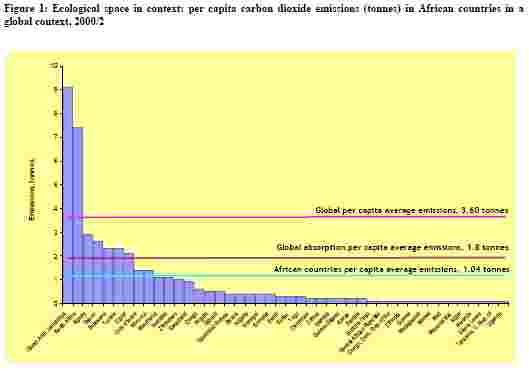
CLIIMATE CHANGE EQUITY: Africans emit the least


In terms of totals, small african countries - Rwanda and Burundi - emit the least in the world and in terms of per capita, the whole continent is below the global average and according to IIED, below the natural sink capacity level. Time to echo the HDR findings "'The world's poorest people are on the frontline. They stand most directly in harm's way - and they have the least resources to cope. This first catastrophe is not a distant future scenario. It is unfolding today, slowing progress towards the Millennium Development Goals and deepening inequalities within and across countries."


Source:The New Times (Rwanda), agrifoodstandards.net and IIED .... by C. Kazooba, S. Mutesi and IIED [Muyeye Chambwera et al]


Rwanda and Burundi are among countries with least carbon emissions in the world.
Rwanda is ranked at 161 emitting about 600,000 tonnes of carbon gasses that cause climate change whereas Burundi is positioned at 167 emitting about 200,000 tonnes in 2004 out of the 177 countries surveyed, according to the 2007/2008 UNDP's Human Development Report released in Kampala yesterday.
Rwanda, which comes after Kenya, Uganda and Tanzania, in 2004, signed the Kyoto Protocol to the Framework Convention on Climate Change and the Cartagena Protocol on Biosafety, both of which limit a country's emission of Carbondioxide.
The United Nations Development Programme report titled: 'Fighting Climate Change: Human Solidarity in a Divided World', warns that the recent devastating climate change would severely affect the world's poorest.
'The world's poorest people are on the frontline. They stand most directly in harm's way - and they have the least resources to cope. This first catastrophe is not a distant future scenario. It is unfolding today, slowing progress towards the Millennium Development Goals and deepening inequalities within and across countries.
Left unattended, it will lead to human development reversals throughout the 21st century,' the report reveals.
It adds that climate change through its impact on ecology, rainfall, temperature and weather systems, global warming will directly affect all countries.
'However, some countries and people are more vulnerable than others. In the long-term, the whole of humanity faces risks but more immediately, the risks and vulnerabilities are skewed towards the world's poorest people,' it said.
The world's temperature is reported to have grown by around 0.7 degrees centigrade since the advent of the industrial era, according to the research.
'The trend is accelerating at average global mean temperature is rising at 0.2 degrees centigrade every decade.'